
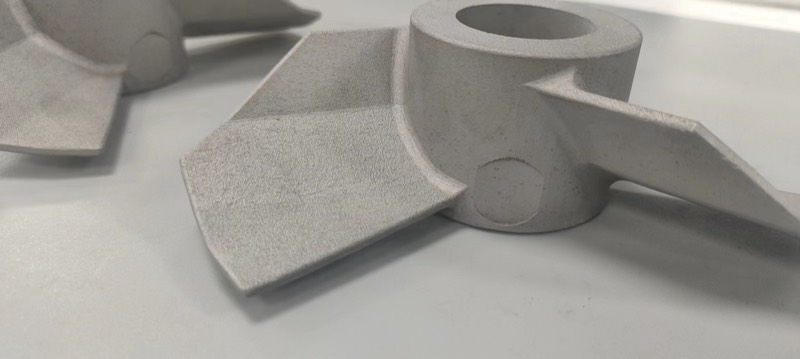
Metal 3D printing by SLM (selective laser melting, also called DMLS or laser powder bed fusion) produces dense, functional metal parts directly from a 3D file, with no mould and no fixture. It is the process of choice for internal cooling channels, lattice structures, lightweight brackets and assemblies merged into a single part. But it is not the answer to every metal part. Here is what engineering and purchasing teams need to know before ordering: the alloys, the lead times and the factors that really drive the price.
How SLM works
A thin layer of metal powder is spread over a build plate, and a laser melts the cross-section of the part. The plate lowers, a new layer is spread, and the cycle repeats until the part is complete. Overhanging areas are held by support structures, which also anchor the part to the plate. After printing, the parts are usually stress-relieved, cut from the plate, cleaned of supports and, if needed, heat-treated, machined and finished.
Which alloy for which application?
| Alloy | Strengths | Typical industrial uses |
|---|---|---|
| Aluminium AlSi10Mg | Light, good thermal conductivity, among the most economical alloys | Housings, heat exchangers, brackets, functional prototypes |
| Stainless steel 316L | Corrosion resistance, good ductility, easy to post-machine | Fluid parts, food and process equipment, tooling inserts |
| Titanium Ti6Al4V | Excellent strength-to-weight ratio, biocompatible grades | Aerospace and motorsport parts, lightweight structural brackets |
| Inconel 718 / 625 | Strength and oxidation resistance at high temperature | Turbine and exhaust parts, burners, hot-section components |
Other alloys are possible on request: send your material specification with your files. If you only need a quick functional check, aluminium or stainless steel is often enough before moving to titanium or Inconel for the final part.
What drives the cost of an SLM part
- Height in the build: build time depends mainly on the number of layers. A tall part costs more than a flat one of the same volume, so orientation matters.
- Volume of metal: solid sections consume powder and laser time. Hollowing, lattices and topology optimisation reduce both.
- Supports: every support has to be printed, removed and finished. Self-supporting angles and channels lower the bill.
- Alloy: aluminium and stainless steel are usually the most economical; titanium and Inconel cost more, in powder and in processing.
- Quantity and nesting: several parts printed on the same plate share the machine time, so the unit price drops as quantities grow.
- Post-processing: heat treatment, CNC finishing of bores and sealing faces, threads, shot blasting or polishing, and inspection requirements.
What sets the lead time
Lead time is the sum of four steps: preparation of the build, printing (from several hours to a few days depending on height and the number of parts), heat treatment, then machining, finishing and inspection. A simple part with standard finishing moves fast; a part with a specific heat treatment, many machined features or a full dimensional report takes longer. Tell us your deadline when you ask for a quote: we plan the build and the finishing steps to meet it.
Design tips that save time and money
- Keep walls at about 0.8 mm minimum, and avoid large flat surfaces parallel to the plate.
- Design overhangs and channels to be self-supporting wherever possible: teardrop or diamond-shaped channels instead of flat-topped ones.
- Add machining allowance on critical bores, sealing faces and threads: they are finished by CNC machining after printing.
- Remove unnecessary mass: SLM rewards lightweight design.
- Indicate on the drawing which surfaces are functional and which can stay as printed.
SLM or CNC machining?
For simple, prismatic parts, CNC machining is usually faster and more economical. SLM becomes the better choice when the geometry cannot be machined (internal channels, lattices, organic shapes), when several machined parts can be merged into one, or when weight matters. Many projects combine both: a printed blank, with critical features finished on a CNC machine. Typical SLM accuracy is about 0.1 mm on most dimensions, and tighter on machined features.
What to send for an accurate quote
- Your 3D file (STEP preferred) and a drawing with tolerances
- The alloy, and any required heat treatment or standard
- Quantities: prototypes, then expected series
- Surfaces to machine, roughness and finishing requirements
- Documents you need: material certificate, inspection report
Have a metal part in mind? Request your free quote: you receive it within 24 hours, and an engineer recommends the right process for your parts. Find all alloys and limits on our metal 3D printing page.